
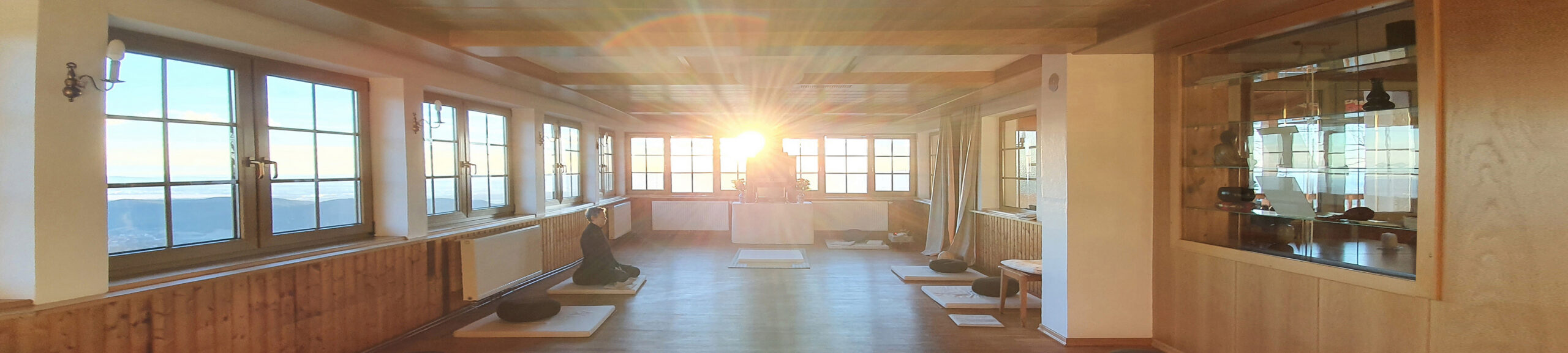
How does one practise Zen?
Zen must be learned, practised and also carried out. The heart of Zen practice is Zazen. This particular form of meditation, which differs from all other meditation techniques, can be learned through practice. It requires, however, right motivation as well as patience, effort and discipline – qualities that the practice itself cultivates.
Formal Zen practice begins with the simplest things we can do while awake: we sit and we breathe. This is the starting point for simple activities such as walking, cleaning, eating or reciting.
Sitting meditation – Zazen

In Zazen we concentrate at first on the breath, allowing it to flow gently and quite naturally. This method of attending to the breath is also used in other schools of meditation. Counting the out-breath from 1 to 10 can support concentration on the breathing. In formal Zen meditation training the individual sitting periods last about half an hour. During sitting meditation we try to let body and mind be occupied solely with the simple act of sitting and breathing.
Zazen is best practised in a quiet room, motionless on a cushion, in an upright sitting posture, with a thick mat or blanket underneath. The legs can take various positions: full lotus, half lotus, Burmese posture, kneeling posture (with or without a meditation bench). What matters in every case is that the knees rest firmly on the ground. The head is held straight, the chin drawn back slightly so that the neck is extended and the ears are vertically above the shoulders. With the knees one sinks, as it were, into the earth like the root of a tree; the upper body is upright and resembles a trunk; the head reaches towards the sky.
The hands form the meditation mudra. The left hand rests in the right. The thumbs touch lightly at the tips, forming a nice oval that encloses the navel. The elbows are angled slightly outwards, because the arms should not touch the body and the armpits should have room for a fist. The eyes are half open. The gaze is still, but relaxed, directed at the floor about one metre in front of the body. More detailed instruction is given by experienced practitioners.
Walking meditation – Kinhin

After the sitting period we move with the same state of mind as in Zazen into a conscious form of movement. Everyone walks in a single line, one behind the other, and each step is taken mindfully: this is called walking meditation or Kinhin. The hands are in Shashu: they are placed flat on top of each other in front of the chest, the left hand in front of the right, with the thumbs crossed. The elbows are angled slightly away from the body so that the forearms form a straight line. In Zen we strive, while walking – and ultimately in everything we do – for the same collected concentration to which we give a concrete form while sitting.
Even if someone would prefer to continue sitting in the meditation hall, Kinhin is the clear invitation to let go of Zazen and move on to the next activity. No fixation on sitting, no fixation on walking. What matters is to maintain a clear focus, while at the same time cultivating the ability to be in flow with changing circumstances. This makes up a significant part of Zen practice.
Sutras – Recitation

As part of formal practice we recite sutras, i.e. Buddhist discourses, in a kind of chant. The aim, however, is not to reflect on the intellectual meaning of the words. Rather, what counts is the immediate experience of connecting completely with the surroundings – or losing oneself in them – through the production of sound. After reciting we make three deep bows. Not to pay homage to any external thing, but as a means of merging with our whole body in a single simple action.
What does Zazen do?
The purpose of this practice is to calm the restless mind, to “tame” it. For only a calm mind is a clear mind. And only when the mind is clear and tamed can we work with it and begin with actual Zazen. What is essential here is to leave behind dualistic, discriminating thinking. In Zazen we should recognise our “true” nature and realise it. We learn to see things as they really are.
Normally we see things as they simply appear to us and as we interpret them. This often leads to misinterpretations and misunderstandings. Through Zazen we gradually learn to recognise our own patterns according to which we think, speak and act. We also recognise where we are “stuck”. For it is precisely the inability to let go, the clinging, that creates most of our problems – and so often leads to painful experiences!
With the help of Zazen we can not only get to know ourselves better, but also gain insight into many aspects of so-called reality. Zazen should be practised, if possible, with an experienced teacher, as problems may arise that are a hindrance to Zen practice. Zazen has therapeutic effects, but should never be regarded as a substitute for psychotherapy!
The main emphasis of Zen practice lies in the practical exercise of Zazen and the integration of the insights gained into everyday life. In advanced phases, knowledge of the foundations of Zen Buddhism is also helpful, as they have been handed down in the sutras and writings of the great teachers. However, it must not be overlooked that a deep and genuine understanding of these foundations can only be achieved through intuitive insight while practising Zazen.
What is Zen?